Thursday, October 14, 2021

Backyard garden reality revisited, part 2: fun with garden design


In the last post I estimated the amount of calories, protein, and calcium that this year’s vegetable garden design can provide, using a combination of yields obtained for crops already harvested and the best yields I have obtained from previous years’ gardens for those crops still in the ground or that failed. I want to emphasize once again that I used actual yields that I have obtained for actual varieties in my actual garden in order to do this nutritional analysis. All other attempts that I know of to analyze the nutrition available from a small backyard garden have assumed Ecology Action’s mid-range yields for a small number of crops that may or may not grow in a particular region. Furthermore, the minimum-area designs in One Circle do not allow for easy crop rotation, so it might be difficult to sustain yields over a period of years.


My 2021 garden falls far short of providing enough nutrition to sustain one adult human for a year because it does not grow a large enough area of high-calorie crops such as grains, potatoes, leeks, and garlic. Suppose, then, I design the garden in blocks that I can rotate such that no plant family is repeated in the same bed more often than once in four years and include higher percentages of the high-calorie crops in the design than I do in my actual garden. Crop rotation reduces the buildup of pests and diseases that can happen when crops of one plant family are grown repeatedly on the same land area, and it also helps to avoid imbalances in soil minerals that can build up under the same conditions. What is the minimum area of this type of design to provide an adult with a full year’s worth of calories, protein, and calcium?


Ecology Action suggests that a minimum-area garden should have grain and fava bean crops planted in about 60% of the garden, potatoes or other high-calorie root crops in about 30% of the garden, and the rest planted to all the other crops. If we are to have a four year rotation between crop families like the grass family (corn), the bean family (soybeans) and the nightshade family (potatoes), then a garden plan allowing for that rotation would include one block of corn; one block of soybeans; one block of potatoes; and one block containing crops in plant families other than those three. This last block should contain substantial amounts of Ecology Action’s other special root crops, as given on page 40 of the 8th edition of How to Grow More Vegetables (HTGMV).


Let’s start with a 1600 square foot garden design containing four blocks of 400 square feet each. Each 400 square foot block contains four 100 square foot beds. I’ll design the garden as follows.


Block 1: four 100 square foot beds of dent corn.

Block 2: four 100 square foot beds of soybeans, harvested green.

Block 3: four 100 square foot beds of potatoes. After the potato harvest two of the beds are planted to turnips (cabbage family), with both the greens and the roots being eaten, while the other two beds are planted to bok choy (cabbage family).


The four beds in Block 4 will be planted as follows:

            One 100 square foot bed to winter squash (cucurbit family)

            One 100 square foot bed to beets (amaranth family)

            One 100 square foot bed planted half to leeks and half to elephant garlic (allium family)

            One 100 square foot bed planted to potato onions (allium family)


Notice that the garden design allots about 25% of the garden area to a grain (corn) and another 25% to soybeans (not fava beans as HTGMV recommends, which don’t grow well in this climate). About 30% is planted to potatoes, garlic, and leeks among the special root crops. The other beds are planted to other crops that yield well in my garden and are good sources of various nutrients but are not as efficient at producing either calories or protein.


The spreadsheet below shows the calories, protein, and calcium this garden design provides. The values for calories, protein, and calcium per pound for each crop were obtained from the 8th edition of HTGMV. The yields are the best I have obtained for that crop as shown in the spreadsheet in my post on the 2020 garden results or, for crops that have already been harvested, the yields I have obtained in 2021. As with the previous post, I compared the result to the daily requirements for calories, protein, and calcium as given in the book One Circle.


This is encouraging; the calories have more than doubled compared to the 2021 garden design although still not up to the daily need, protein is borderline, and there is more than enough calcium. Suppose I increase the garden design to 2000 square feet, planted as follows:


Block 1: five 100 square foot beds of dent corn.

Block 2: five 100 square foot beds of soybeans.

Block 3: five 100 square foot beds of potatoes followed by three 100 square foot beds of turnips and two 100 square foot beds of bok choy.

Block 4: one 100 square foot bed each of garlic, leeks, beets, potato onions, and squash.


The spreadsheet below gives the calories, protein, and calcium for this garden design. The values are higher, but still short of the daily requirement for calories.


If I designed a garden with a higher percent of the area devoted to corn and potatoes, a garden of about this size would provide an even higher fraction of the daily requirement for calories and protein. To do this, let’s consider a design with a three year rotation, as in my real-life garden. Here’s a design for a 1500 square foot garden with a three year rotation:


Block 1: five 100 square foot beds of dent corn.

Block 2: five 100 square foot beds of potatoes, followed by three 100 square foot beds of turnips and two 100 square foot beds of bok choy.

Block 3: two 100 square foot beds of potato onions followed by soybeans, harvested green; 50 square feet of garlic followed by soybeans; 50 square feet of leeks; one 100 square foot bed of beets; one 100 square foot bed of winter squash.


This design provides almost as many calories as the 2000 square foot design in a smaller space than the 1600 square foot design. My three year rotation scheme has kept pests and disease at a low-enough level for the past decade, so I think that a three year rotation plan is good enough.


Could a 2100 square foot garden with a three year crop rotation provide enough calories for one vegan adult for a year? Let’s find out. Here is the design:


Block 1: seven 100 square foot beds of dent corn.

Block 2: seven 100 square foot beds of potatoes, followed by six 100 square foot beds of turnips and one 100 square foot bed of bok choy.

Block 3: two 100 square foot beds of beets; one 100 square foot bed of winter squash; one 100 square foot bed of leeks; one 100 square foot bed of garlic; two 100 square foot beds of potato onions. The garlic and potato onion beds are followed by soybeans (three 100 square foot beds).


And here is the spreadsheet:


Finally, a design that provides marginally enough calories and more than sufficient protein and calcium for one vegan adult for a year; that allows for an easy three year crop rotation; and that uses crops I actually grow, plants them as I do in my garden, and assumes yields I have actually attained!


Now let’s step back and look more closely at the design with a gardener’s eye.


First, remember that yields vary from year to year for many different reasons, such as unusual weather conditions, spotty germination of seeds, pest or disease problems, and/or other issues. Thus in any one year the actual amount of calories, protein, and calcium obtained from the harvest may not be as high as the amount shown.


Could that be compensated for by increasing yields? Possibly. For one, there are far more varieties of each of these crops than I have tried. Maybe a different variety would yield more than the variety that I grow.


Or I might be able to plant certain crops more closely spaced than I have been. I think I could plant garlic, potato onions, and maybe leeks the same distance apart within the row (6 inches) as I do now but with rows 8 to 9 inches apart rather than 12 inches apart. It’s possible that corn stations could be 18 inches apart within a row. Potatoes might be planted 8 or 9 inches apart rather than 12 inches. All of these would increase the number of plants in a 100 square foot bed, which could increase the yield as long as the plants still can access sufficient resources from the soil. I haven’t grown soybeans enough years to know how to best plant them, so I might be able to increase their yield as well.


Earlier this year I read Kelly Winterton’s publications on potato onions (look toward the bottom for the links). He suggests doing two things to increase the yield of potato onions: soak them in a weak bleach solution before planting them, and plant them in early spring rather than in autumn (he spring plants in Utah). While most of the larger bulbs that I plant in autumn survive the winter under mulch, many to most of the smaller ones – which is most of what I plant – rot either before the mulch is removed or in the first month or so afterward. Following Kelly’s methods might lead to higher yields.


Taking all this together, I feel reasonably safe in saying that a 2100 square foot garden in the St. Louis region, planted according to my design, could potentially provide all of the calories, protein, and calcium for one vegan adult for one year if year-to-year yield variability can be compensated for by increasing the yields through good variety choice and closer plant spacing.


However, there is much more to the minimum-area garden than a design on paper. As I have discussed before, there are a host of other issues, from garden labor to preserving the harvest to meal planning to psychological and cultural issues surrounding diet that I need to address with the garden design that I have developed, just as I did with the minimum-area designs in One Circle. In the next post I’ll tackle these.


Wednesday, August 25, 2021

Backyard garden reality revisited, part 1: can my current garden feed me for a year?


Late summer color provided by sweet coneflowers.

In 2013 I critiqued a concept that has become embedded in discussions about living sustainably: that it is possible to grow all the required calories and nutrients needed to maintain health for a vegan diet for one adult in a space of 1400 square feet or less. David Duhon designed gardens intended to do just that using the medium yields for crops in John Jeavons’ book How to Grow More Vegetables and published his results in the book One Circle. While I find the procedure Duhon used to be valuable in analyzing the nutritional possibilities of a small garden space, a careful reading of that book and subsequent garden design publications from Ecology Action shows that these are thought experiments only. The most recent small garden diet design I’ve seen from a source outside of Ecology Action is also a thought experiment. I wanted to know if a real gardener in a particular place could obtain high enough yields to grow a complete diet for a vegan adult in 1400 square feet or less while also practicing sustainable gardening principles such as crop rotation and soil re-mineralization. I promptly volunteered myself for the role of that real gardener and have spent the last 8 growing seasons seeking to answer the question for my suburban St. Louis, Missouri garden. Now I have learned enough to wrap up the project in this and the next few posts. I’ll begin with my current garden design and ask what percentage of an adult vegan’s diet for a year it can supply.


I garden in a fenced-off area of the backyard with full sun exposure containing twelve 100 square foot beds separated by paths. This post discusses the reasons for my adoption of the gardening techniques and soil re-mineralization methods described by Steve Solomon rather than those promoted by Ecology Action. Each report on the previous year’s garden such as the most recent report includes the spacing and timing for each crop I grew that year and the yield I obtained. I have set up the garden so that the group of three beds of corn rotates as a block through the nine beds planted to grains or vegetables, so that any one bed in the garden is grown to corn one year, then to something other than corn for the next two years. Each of the other beds is rotated so that no bed is grown to crops of the same plant family two years in a row. This feature addresses one of the major flaws in Duhon’s designs, the inability to rotate crops properly. My garden design addresses the climate limitations of my location, such as the inability to overwinter any crops other than potato onions and garlic in an open garden. The very short springs and autumns I experience restrict double-cropping, a feature of Duhon’s designs that does not translate well to this climate.


The beds in the 2021 garden are planted as follows. Each bed is 4 feet by 25 feet, for a total of 100 square feet of growing space in each bed.

·      One bed of annual and perennial flowers and herbs, including sorrel, the only crop eaten as a vegetable from this bed

·      One bed of strawberries

·      One bed of raspberries

·      Three beds of popcorn, two of which also include naked-seeded pumpkin vines

·      One bed consisting of peppers, tomatoes, eggplants, and basil

·      One bed of squash-family plants (summer and winter squash including zucchini, cucumbers, and muskmelons)

·      One bed of overwintering potato onions and garlic. After June harvest, this bed was replanted to a mix of zinnia, sunflowers, cucumbers, soybeans (for edamame), and zucchini

·      One bed of bean-family plants (green and lima beans and cowpeas)

·      One bed of potatoes. After the potato harvest this bed was planted to an autumn crop of greens and roots, mostly from the cabbage family but also to include lettuce

·      One bed of spring-planted greens and roots, including lettuce, cabbage, bok choy, carrots, beets, and leeks


The spreadsheet below includes the names of each variety of each crop that I am growing this year; whether or not the crop is a grain (G), dry bean (B) or special root crop (R) according to Ecology Action; a yield I have obtained for that crop, in pounds per 100 square feet; and the number of square feet of garden space I have allotted for that crop in the 2021 garden.


Because I am in the middle of the growing season, I only have a yield for 2021 for the crops I have already removed from the garden. On the spreadsheet, those crops are in bold type. Some of the varieties I’m growing this year are new to me. Those crops are in italic type. For these crops, I have reported the best yield I have obtained for a similar variety that I have grown.


For the rest of the crops, I have reported the best yield I have so far obtained for that crop. Some of the crops may yield better than that this year. Some may not yield as well. Thus the best I can do is approximate the percentage of a complete diet for one vegan adult that I will grow this year. You’ll soon see that this is good enough to answer the question.


In the case of popcorn, some animal – I suspect squirrels – has already eaten every single ear on every plant. In its place, I have substituted the dent corn variety that I have grown in previous years and the best yield I obtained for it, which occurred in 2019. Thus the results given in the spreadsheet are actually an overestimate of the nutrition that the 2021 garden will provide. However, including it gives an upper limit to how much nutrition this garden design is capable of providing when everything goes right.


How To Grow More Vegetables includes the calories, protein (in grams), and calcium (in milligrams) for each crop listed in the Master Charts. Using the total weight of each crop that I have already harvested or that I can reasonably expect to harvest, I multiplied the per-pound values given in HTGMV by the weight of each crop in pounds to obtain the total calories, protein, and calcium provided by that crop. Summing up the columns for each of those provides the total amount of calories, protein, and calcium that I estimate I will harvest from the garden in 2021. Then I divided that number by 365 to obtain the daily amount of each, to compare with the dietary needs chart on pages 69-71 in One Circle


No, my current garden will not supply me with sufficient calories, protein, or calcium to sustain me for a full year. In fact, it falls quite far from that standard in both calories and protein, by a factor of three to five. In terms of calcium it does somewhat better, supplying me with close to half of what I need for a year. Since two adults are eating from this garden, the garden falls even farther short of supplying us with a complete diet.


Why does Ecology Action highlight grains, dry beans, and certain root crops in their gardening method? A look at the spreadsheet gives the answer. The corn crop provided by far the highest amount of calories compared to any other crop – more than half of the total, in fact. Potatoes, one of the special root crops, were also a significant source of calories, as were soybeans even though they were eaten green rather than dry. If the cowpeas had yielded better they also would have been a significant source of calories. The corn, potatoes, and soybeans were also the most significant sources of protein. Garlic and leeks provided good amounts of calories for the small amount harvested. This is why Ecology Action recommends allotting about 60% of garden space to grain crops (this category also includes dry beans), about 30% to high yielding root crops such as potatoes, garlic, and leeks, and about 10% to everything else. Such a design, however, has the disadvantage of not allowing for crop rotation unless you include grain crops that are not in the grass family, such as sorghum or quinoa, in the grain crop area in sufficient quantity to avoid growing plants in the same crop family in any bed two or more years in a row.


Using the current garden design, then, my garden would need to be four times the size it now is, or 4400 square feet, to provide a just-sufficient amount of calories and protein for my needs. Could a change in design using the same crops that also allows for proper crop rotation reduce the space needed to grow a complete diet? I’ll investigate that possibility in the next post.

Sunday, July 25, 2021

A slice of garden life: the harvest of July 22

I have received a request to post pictures of a recent harvest to this blog. Since I’m still in the process of writing a post on the nutritional content of this year’s garden and whether or not it would be sufficient for a complete diet for a vegan adult for a year, this is a good time for a quick post that’s heavy with pictures. The pictures below show the complete harvest of July 22.


At this time of year I’m primarily harvesting squashes, cucumbers, and tomatoes. Although I could have chosen to harvest some beets and carrots as well, we have enough vegetables in the refrigerator to leave the beets and carrots in the ground for now.


With that said, let’s begin with the cucumbers and zucchini I harvested on the 22nd. You’ll see them below. The basket is 11.5 inches in diameter. Mike added the cucumbers to the pickling container for us to eat as pickles later on. We use some of the zucchini raw, adding tomatoes, onions, and carrots to make a salad. The rest of the zucchini is used in stir-fried dishes.


In the next picture, the same basket holds six ‘Desi’ summer squash. These will all find their way into stir-fries.


Below you’ll see two of the four heirloom tomato varieties I’m growing in the same basket. The yellow tomato with red stripes is ‘Old German.’ It’s not as productive as the others, but we enjoy it for its flavor and contrasting color in the summer salads I described. By itself the tomato weighs nearly one pound! The surrounding tomatoes are ‘Arkansas Traveler,’ a workhorse of a tomato in this climate. It combines great taste with no green shoulders, depriving the compost pile of some material and leaving more tomato for us to eat.


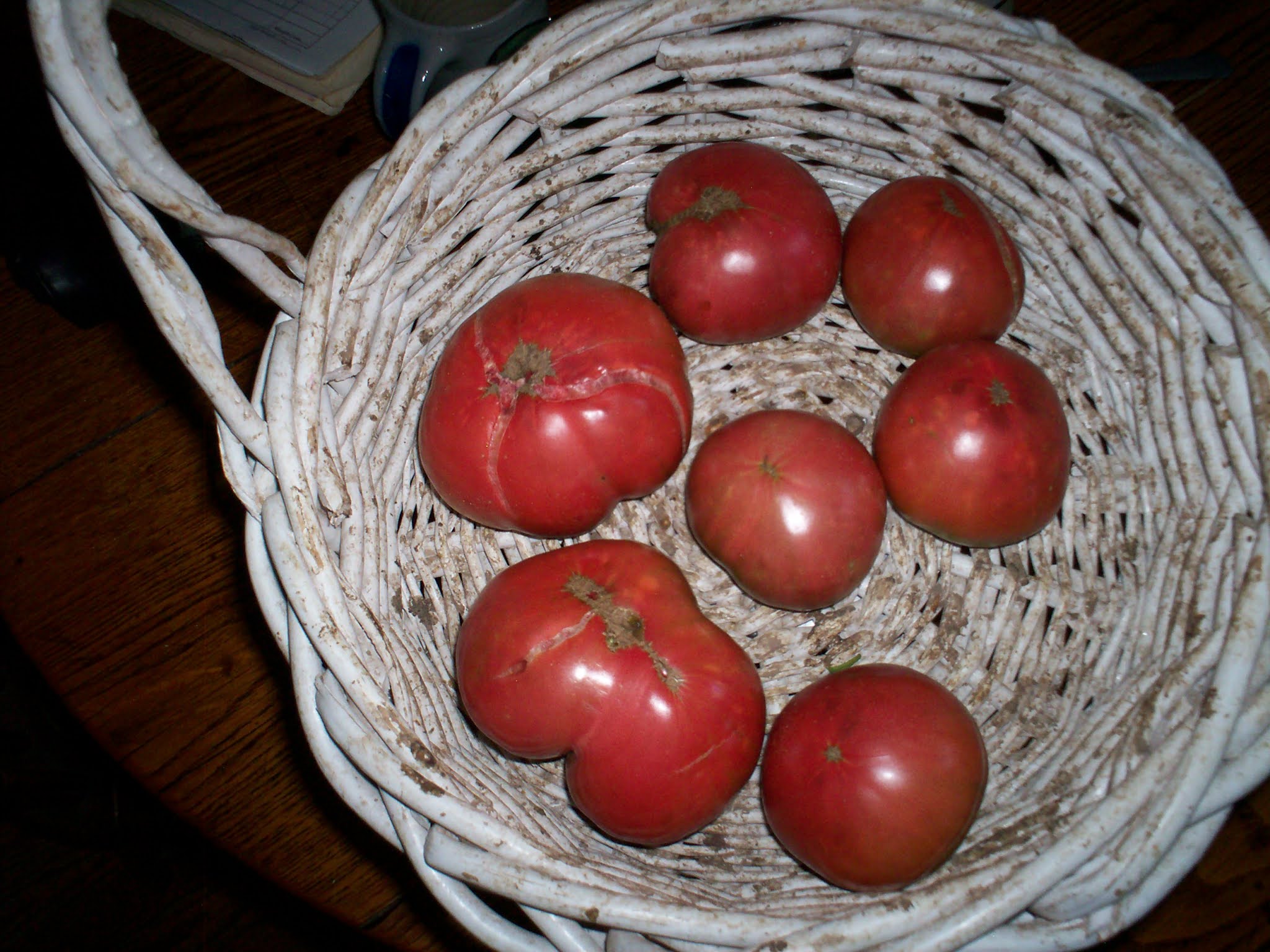
In the next picture you’ll see ‘Cherokee Purple’ tomatoes in the same basket. They are larger, more variable in shape and size, and darker in color than the ‘Arkansas Traveler’ tomatoes. Like the ‘Old German’ tomatoes, the ‘Cherokee Purple’ tomatoes sport green shoulders. By green shoulders, I mean that when these tomatoes are fully ripe, the area around the blossom end will retain some green color and unripe flavor. We cut the green shoulders off and compost them. For both of these tomatoes, the taste is worth putting up with the green shoulders.


Each of the three tomatoes already shown find their way into salads, with excesses being turned into tomato sauce. The final tomato variety shown below in the same basket, ‘Roma VF’ is a paste tomato that we use exclusively for tomato sauce. It has less pronounced flavor than the others, but it also has less water so it adds volume to the sauce.


We are still waiting for some other summer crops to size up (green beans, eggplants, potatoes) or ripen (sweet peppers, raspberries). Today, the 25th, I harvested the first ripe red sweet pepper. Within the next couple of weeks we should be harvesting the first crops of each of the rest of these.


That’s all for now. Enjoy whatever is in season where you live!


Wednesday, July 7, 2021

Miscellany


Strawberries!


While you’re waiting for the next post, I have a couple of announcements.


First, the Sustainable Backyard Network is holding the Sustainable Backyard Tour as a virtual event this year. Mike’s and my yard will be included on the virtual tour, which takes place on Sunday, July 11th on the Network’s YouTube channel. Once you’re there, click on Uploads to see the videos of each yard on the Tour. The one I’m in is called The Intelligent Gardener. You won’t go wrong watching any of them, because they are full of good ideas for people with small spaces, large spaces, and anything in between. I’ll be watching all of them soon!


Second, as of this month Blogger is no longer supporting the FeedBurner app that allowed you to follow this blog through email. I’m in the process of moving to FeedBlitz for the follow-by-email function. Those of you who receive email notice of new posts may find you receive two emails (or maybe more) of the same post while the changeover occurs. I hope that you’ll be patient with me as I become comfortable with the new app.


Thank you for reading and for your comments! See you later this month with the next post.

Wednesday, May 5, 2021

What I'm asking the garden in 2021


The garden on May 4. The bed to the left has lettuce, mustard greens, beets, leeks, carrots, cabbage, and bok choy. The bed on the right has potatoes.

Since 2018 I have been asking my garden if some potential soil amendments that I produce at home can replace some of the soil amendments that I import into the garden. Worm castings, one of the potential soil amendments for replacing nitrogen, turned out to be too difficult to apply and too low potency for the small amount of it that I have available. I have also trialed two other materials, urine as a source of nitrogen and wood ashes as a source of calcium, phosphorus, and potassium.


In the last two years the garden told me that urine is as effective as cottonseed meal to provide nitrogen for some kinds of plants, such as corn and tomatoes. In other cases, such as for root crops, it may be less effective than cottonseed meal. It also told me that I can use as much as seven pounds of wood ashes in a garden bed and not raise the pH too much, but that it would be preferable to use that much on crops that will make good use of all the potassium that it brings. However, having only used that large quantity of wood ashes on one crop family, the alliums (garlic and potato onions) that did not make the best use of the excess potassium, I did not know how it might affect other crops.


The first two beds I plant each spring are the potato bed and the bed with greens and roots. I had some cottonseed meal left over from 2019. These crops seem to do better with cottonseed meal than urine. Rather than take the time to look more closely at the soil test results, I used the usual amount of cottonseed meal and just enough wood ashes to make up a magnesium deficiency, using Tennessee brown rock to provide the rest of the phosphorus the beds needed. Then I got those plants into the ground while I gave the whole issue more thought.


Mineral deficits from soil testing. The results from this spring are in the rightmost column.

The garden is settling into a pattern of a few small deficits each season after 8 years of re-mineralization. Organic matter is in the range of 3 to 4%, which is about the best that I can expect for the amount of compost I add and the heat and length of the growing season. The pH is in the right range for vegetables and the TCEC shows that the light silt loam nature of the soil remains unchanged despite adding purchased humates. On the other hand, sulfur and phosphorus deficits have dropped to low levels. Part of the reason I am adding the humates is that they can adsorb and hold sulfur and phosphorus anions; it may be working. The lower the phosphorus deficit, the more likely it is that I can remedy it by adding sufficient wood ashes without needing to add such a large amount as to increase the pH above 7.0. The humates are stable so I should be able to stop adding them at some point. Magnesium is a little deficient, but I can easily add enough wood ashes to remedy it. The sulfur deficiency is easy to remedy with gypsum, the boron deficiency is easy to remedy with borax, and the zinc deficiency is too small to worry about.


Having noticed all that, I decided there were two questions for this year’s garden.

1.     Do I want to use cottonseed meal or urine to add nitrogen to the garden beds this year? Cottonseed meal is easy to apply when I prepare each bed, but I have to buy it. I make my own urine, but last year’s results suggest that I don’t make enough of it to provide all the nitrogen that the spring and summer crops need. I could ask Mike to contribute, but it’s harder to control the amount I add in that case.

2.     Do I want to use a rock source of phosphorus or use wood ashes to make up the phosphorus deficiency? Both are easy to apply when I prepare the bed. I have to buy the rock source. We have wood ashes from the wood stove to make use of, and this year adding a little over 2 pounds to each bed is enough to remedy the phosphorus and magnesium deficiency. Most likely I have enough wood ashes for all of the beds. I will be adding more calcium to an already existing excess if I use wood ashes, but we get rain during the growing season so it would be almost impossible to add so much as to create an undesirable layer of caliche. It’s only a 10% or so excess anyway.


Eventually I realized that I can ask the garden to answer the following questions this year.


1.     In the bed in which I planted the tomatoes, peppers, and eggplants, I added the full 2 plus pounds of wood ashes to remedy the phosphorus and magnesium deficiencies. This bed produced good yields last year with urine as the nitrogen source, so I will collect urine for it this year as well. It will be easy to collect the 15 or so days’ worth of urine that it will need between now and the beginning of October. This bed will answer the question of the effect of adding both urine and wood ashes on yield, taste, and disease and insect pressure.

2.     I will use the full 2 plus pounds of wood ashes and cottonseed meal on all remaining beds as long as I have enough wood ashes to do so. All of these beds will answer the question of the effect of using wood ashes along with cottonseed meal on yield, taste, and disease and insect pressure. Only on the bed with garlic and potato onions have I done that before and I used about a factor of three more wood ashes that time.


That’s all for now. See you in another month or so!


Wednesday, April 28, 2021

Update and link to interview of me

Accumulating snow on April 20. Note the redbuds and dogwood in bloom.

Last week Mike and I experienced accumulating snow. It's certainly not the first time it has snowed in April in St. Louis. In fact it's not that uncommon to receive snow in early April. However, in the 36 Aprils I have lived in St. Louis, none has included an accumulating snow after the middle of the month, until this one. 

It was bad enough to receive snow, but worse that it was accompanied by two freezes, on the mornings of April 21 (30F) and April 22 (32F). All of the fruit trees except for the persimmons had flowered and leafed out. Only the pawpaw trees show damage to the leaves and flowers, so it could have been worse. I won't know how significantly this year's pawpaw crop has been affected for some time.

This isn't the post I promised you on what I'm asking the garden this year. After I complete another writing commitment I will write that post. But I do want to draw your attention to Lisa Brunette and her blog Cat In The Flock. Lisa and I met through a mutual interest in John Michael Greer's work and found out we share gardening and blogging interests and write about our gardens, among other topics, on our blogs. Lisa and her husband Anthony Valterra live in another of St. Louis' many suburbs. In the last year or so we've become friends, and I've become a fan of Lisa's blog (you'll see it over on the blogroll). If you enjoy my blog, you'll enjoy Lisa's as well. I really like her and Anthony's sense of style as well as the practical work that they do. They make living with LESS beautiful!

Recently, as Lisa explains on her blog, she interviewed me and will feature that interview on three posts. You'll find the first post here. The next two go live on May 2 and May 5. I encourage you to read them and to enjoy the other posts on Lisa's blog as well. And thanks to Lisa for the interviews and for her work!

Thursday, April 1, 2021

Peak infrastructure, peak oil


In the previous post I discussed the severe cold wave in Texas that came close to crashing the electrical grid for almost the entire state. The estimated insured loss from the deep freeze in Texas and surrounding states will exceed $10 billion. That doesn’t include the additional cost for the extreme rate hikes in electricity and natural gas when many of the plants went offline; ratepayers will be stuck paying for that for years. Nor does it include the estimated costs for freeze-proofing any of these systems before the next deep freeze occurs.


If the Texas electric grid were the only bit of aging infrastructure that is in desperate need of upgrading, this wouldn’t be a problem outside of Texas. But it isn’t, not by a long shot. The ASCE’s collective grade for all US infrastructure is C-. That’s an average; some of our infrastructure gets D+, D, and even D- grades. Those of you who want to know the grades for the infrastructure in your own state can find it on the linked page.


True, it’s not as if the ASCE is a disinterested observer. Their members stand to benefit financially from upgrading the country’s infrastructure, so I expect them to take the most pessimistic view of the situation. But that doesn’t mean that we aren’t already paying for the infrastructure we’ve got and the upgrades already occurring. And it doesn’t mean that our infrastructure doesn’t need any upgrading; just ask anyone who lost electrical service to freezes, the risk of wildfire, severe storms, and the like, or anyone who lives downstream of a dam that is at risk of failure, or anyone who has to play dodge-a-pothole every time they drive.


From time to time, our politicians take notice of our infrastructure. President Biden has recently proposed a $2 trillion plan that addresses deficiencies in many of the areas highlighted in the ASCE report. (It also contains some items that aren’t strictly infrastructure upgrades but are intended to appeal to the Democratic party base.)


Most politicians, and most people, probably favor improving infrastructure, especially the infrastructure that is closest to them and most obviously in need. But the work can’t be done for free. To pay for the plan, Biden proposes to raise the corporate tax rate from 21% to 28%, a proposal that the Democratic party base will generally favor. However, the Business Roundtable, made up of the CEOs of the nation’s biggest companies, and the US Chamber of Commerce have already denounced the tax rate increase, proposing instead that user fees such as highway and bridge tolls fund the improvements. I’m pretty certain that most ordinary people, who are already paying for infrastructure maintenance and improvement via drastic increases in utility bills (our sewer rates have increased fourfold in the past 17 years and we are being asked to vote on April 6 for yet another rate hike to pay for a bond issue to fund more work on the sewer system), aren’t inclined to agree to higher taxes and user fees to fund the improvements. If I were a betting woman, I’d bet that this proposal isn’t going anywhere in its current form. No Republican will vote for it, and enough Democrats won’t that it won’t make it out of the Senate, even if it gets through the House, and I’m not sure it will get that far. Possibly a smaller-scaled infrastructure bill will make it through, but such a bill won’t be enough to do more than fund a few pet projects in a few districts whose politicians have enough influence to direct dollars toward them.


Having noted what should be reasonably obvious – that we aren’t willing to pay to maintain all of the infrastructure that we already have – let’s take a look at the entirely new infrastructure that will be required to expand the use of so-called “green” electricity. “Green” electricity means electricity that is supposed to release smaller amounts of greenhouse gases like carbon dioxide and methane into the air than is produced from burning fossil fuels. The technologies usually considered in this category are solar and wind powered plants, hydropower (dams), and hydrogen produced from splitting water by solar power and used to power fuel cells that produce electricity. Hydropower is already using all of the best sites, and there are attempts to remove some of those dams for environmental reasons, so I won’t consider it any further. Solar and wind power not only require the solar and wind plants that don’t already exist to be built, but they also require a major upgrade of the existing electrical grid to accommodate the intermittent nature of these two sources, which I have argued above is at best unlikely.


As for hydrogen, the hip new source of “green” electricity, rather than my addressing all the reasons that this is just one more subsidy dumpster, one more rathole for government money, I’ll just direct you over to this blog. Read it and then try to imagine all of the infrastructure that will be required for hydrogen fuel cells to make enough electricity to run enough cars to matter, at an efficiency that is less than that of a standard electric vehicle.


And as if all that isn’t enough, every bit of current infrastructure that must be at least maintained, if not upgraded, and all of the bright shiny new “climate-saving” infrastructure that is being pushed as absolutely necessary by the climate-emergency crowd, requires energy and materials to do so. Specifically, diesel fuel, produced from oil, goes directly or indirectly into maintaining or upgrading existing infrastructure, not to mention producing and deploying and maintaining new infrastructure. I understand why you may not have paid much attention considering what the past year or so has brought to us, but it turns out that we may well have passed peak oil more than two years back. Check out the graphic near the beginning of this Energy Bulletin of world liquid fuel (oil) production (the blue line on the graph). Notice the slow rise to a production peak in the 4th quarter of 2018. Notice that the highest production peak in 2019 didn’t quite match that of the 4th quarter of 2018. Then comes the familiar rapid drop of oil production and consumption in 2020 resulting from the measures put in place in reaction to COVID-19 that were intended to bring us back to “normal.” You’ll notice that the forecast for oil production in 2021 doesn’t make it up to levels we last saw in 2017 until late in the year, and that was, in retrospect, almost surely optimistic given the forecast was made last December when the concern about vaccine-resistant variants of COVID-19 was less than it is now.


Meanwhile, the deep cuts to capital expenditures made by oil companies during the past few years when oil prices dropped to levels that the companies couldn’t profit from suggest, if not too little oil available for the infrastructure upgrades that Biden and other politicians are promoting, at least a rise in the price of oil due to increased demand meeting reduced supply from the reduction in capital spending that would have funded the new sources of oil that infrastructure upgrades and additions require. But oil prices can only rise so high before they drive an economic downturn similar to 2008. I don’t expect us to be able to afford to maintain all of our current infrastructure under these conditions, much less upgrade it or add new infrastructure. Sure, some projects will get funded by political influence and subsidy dumping. But most of us will do more of what we are already doing: paying more money than we already are for services that are no better than, and likely worse then, what we already have, or being forced to drop services in favor of less resource-intensive ways of providing for ourselves.


And that’s why I keep this blog. Why are so many people gardening now? Among other things, it feeds us for less money and less infrastructure than any other way I know of. Why do people need to know about how to stay comfortable in a cooler residence in winter and a warmer residence in summer? Because it’ll reduce the drain on your wallet as utility prices rise to reflect deteriorating infrastructure and energy price spikes. At some point I plan to pick up the human-powered tools theme that I began some years back, because human-powered tools can do most of what fossil-fuel powered tools do without the infrastructure that fossil fuels require. I will probably touch on other aspects of home economics as time goes by, especially if the suspicions I’ve detailed above eventuate.


Next time I’ll write about this year’s garden project. Till then, I wish you all a good April!